> For the complete documentation index, see [llms.txt](https://mintpad.gitbook.io/docs/llms.txt). Markdown versions of documentation pages are available by appending `.md` to page URLs; this page is available as [Markdown](https://mintpad.gitbook.io/docs/features/custom-ipfs-uri.md).
# Custom IPFS URI
If you have **already uploaded** your metadata and images **to IPFS** and you want to enter this information instead of uploading it again to IPFS, you can do using Mintpad.
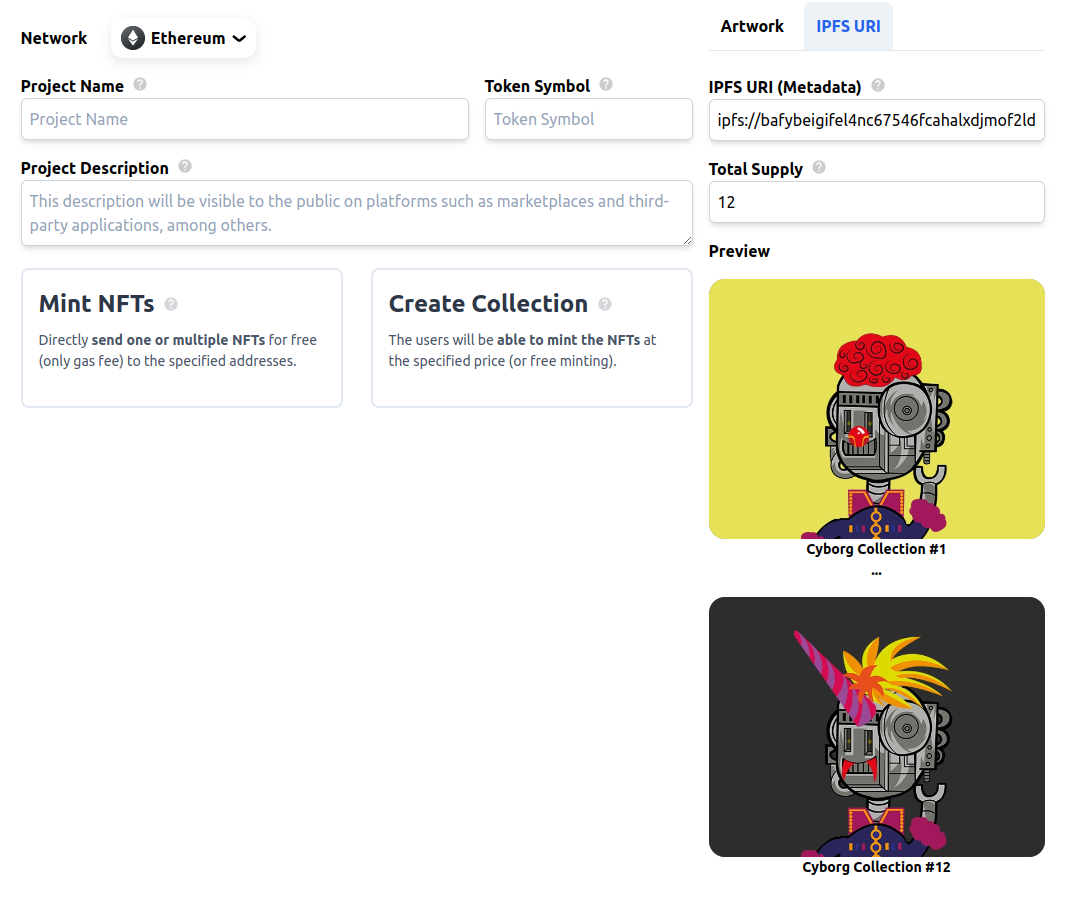
When creating a project, select the "IPFS URI" tab and paste your IPFS URI. This mode is active when creating a new NFT project using the "**Editions**" or "**Drop**" mode.
IPFS URI tab selected creating a project
The **fields that you must fill in are**:
* **IPFS URI** where the metadata is located. At this point, it is important to know the format that should be used in the .json files. The first token has to be **ipfs\://IPFSURI/1.json**, the second would be **ipfs\://IPFSURI/2.json,** and so on until the total supply. If the total supply is 100, the last token would be ipfs\://IPFSURI/100.json. **Important about the IPFSURI** format of "Content Identifiers" (CIDs), some examples would be:
* **v0**: QmdfTbBqBPQ7VNxZEYEj14VmRuZBkqFbiwReogJgS1zR1n
* **v1**: bafybeihdwdwdcefgh4dqkjv67uzcmw7ojee6xedzdetojuzjevtenxquvyku
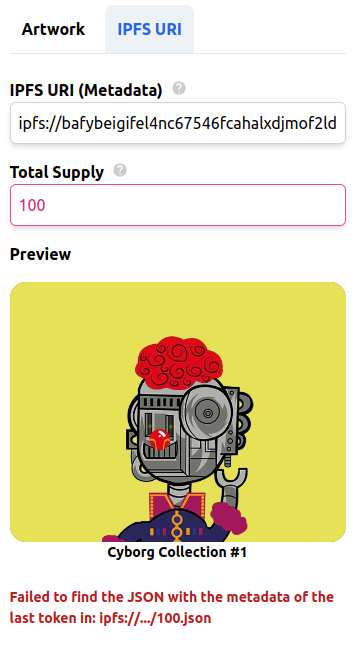
* **Total supply** of the collection. The number must coincide with the number of .json files that have been uploaded. If there is an error, the tool will warn you if it has failed to find the last JSON file, and you will see something like this: